Nail glue is the quiet hero of press-on nails, soft gel tips and nail art. It is also the most misunderstood product on the shelf. "Nail glue" covers two completely different chemistries. One sets in seconds from the moisture in the air. The other stays wet until a UV/LED lamp locks it in place. Choose the wrong one and your nails pop off in a day, or you spend an hour soaking off something that should have lifted in minutes.
This guide sorts every common type into clear categories, compares them side by side, and explains how to apply, remove and troubleshoot each one. The chemistry and safety facts come from published research and poison-control guidance, listed at the end. The application details come from the instructions for our own GEL PARTY glues.
The two families of nail glue
Every nail adhesive falls into one of two families. Knowing which family a product belongs to tells you how it sets, how long it lasts and how it comes off.
Family 1: Air-set glues (cyanoacrylate, no lamp)
Classic nail glue is a cyanoacrylate, the same family of chemicals as household "super glue." Cyanoacrylates start to harden the moment they touch a trace of moisture. The thin film of water on the nail plate, the tip and the surrounding air is enough to trigger a very fast chain reaction (anionic polymerization) that joins the liquid molecules into a solid plastic within seconds. That is why you only need to press and hold.
How air-set glue hardens
Moisture on the surfaces starts a chain reaction that joins cyanoacrylate molecules almost instantly. No lamp is involved.
What this means in practice:
- Fast and convenient. No lamp, no curing, ready in seconds.
- Rigid bond. Cured cyanoacrylate is hard and fairly brittle. It holds very well against pulling but less well against sharp knocks and bending, so press-ons tend to last days rather than weeks.
- Water weakens it over time. The cured polymer is sensitive to water, which is why long hot showers and dishwashing shorten wear. It is also why warm soapy water and glue removers can loosen it.
- It releases heat while setting. A thin film warms only slightly. A big blob can get hot enough to burn skin, so less is more.
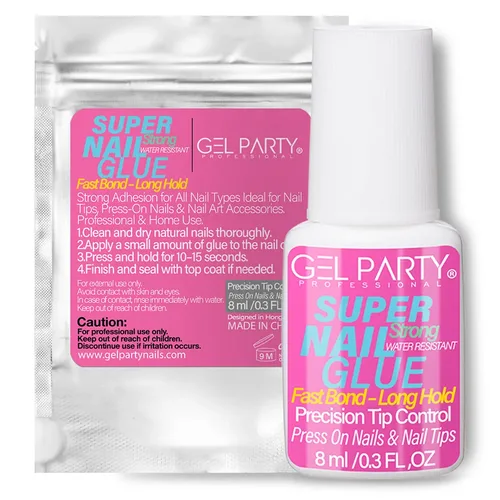
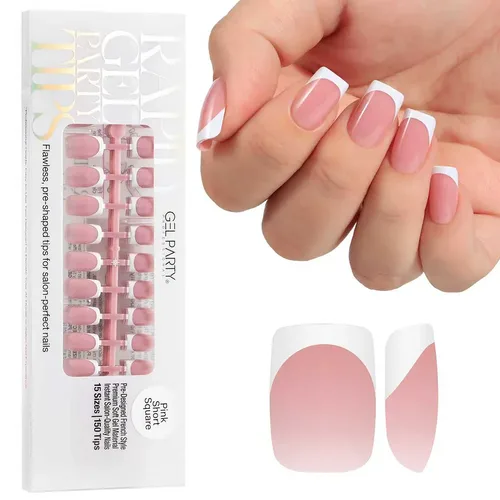
This family includes brush-on nail glue (thin liquid) and semi-solid nail glue (a thickened, gel-like texture that does not run).
Family 2: Light-cured glue gels (UV/LED)
Glue gels look like nail glue but behave like gel polish. They are thick, clear (meth)acrylate gels with a photoinitiator, and they stay soft until you cure them under a UV or LED lamp. You get unlimited time to position the tip. The cured adhesive is tougher and more flexible than air-set glue and becomes one system with the soft gel tip, so it lasts much longer.
This family includes nail glue gel in a tube, solid glue gel in a jar, brush-on glue gel bottles (including 9-in-1 types), soft gel tip adhesive, and rhinestone glue gel.
The main types at a glance
Brush-on nail glue
Thin liquid cyanoacrylate with a built-in brush. Sets in 10–15 seconds. Best for press-ons, quick repairs and sealing a split nail.
Semi-solid nail glue
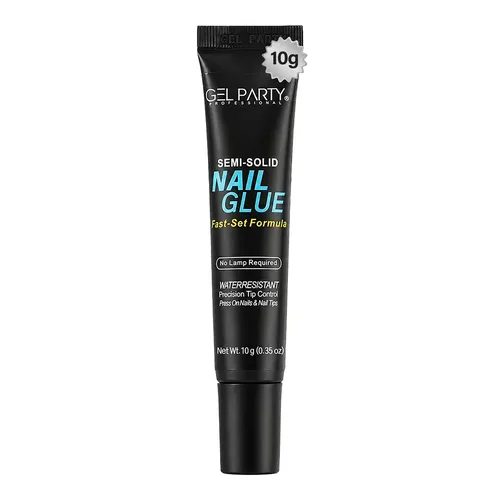
Thick, jelly-like air-set glue that stays where you put it. Hold 20–30 seconds. The easiest no-drip option for press-ons at home.
Nail glue gel (tube)
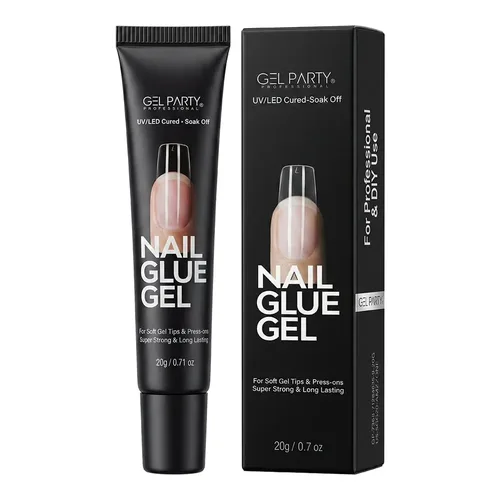
Clear, thick gel with a precise nozzle. Flash-cure 5–10 seconds, then full cure about 60 seconds. Made for soft gel tips that last weeks.
Solid glue gel (jar)
The thickest format. It holds its shape and will not flow toward the cuticle, which makes it easy to control on soft gel tips.
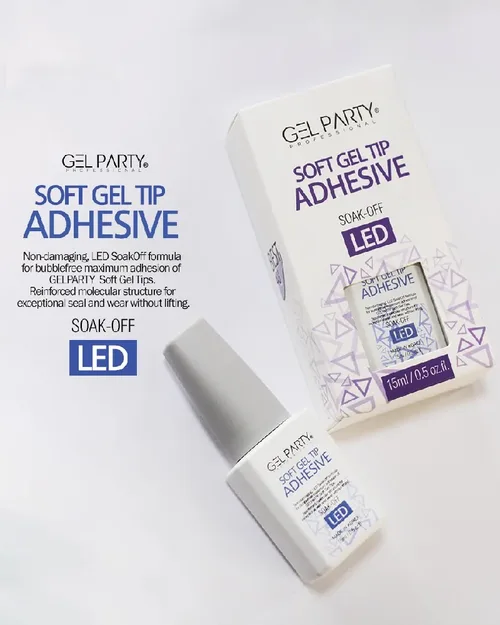
Brush-on glue gel and tip adhesive
Glue gel in a brush bottle for thin, even layers. Multi-use types can also build, strengthen and repair.
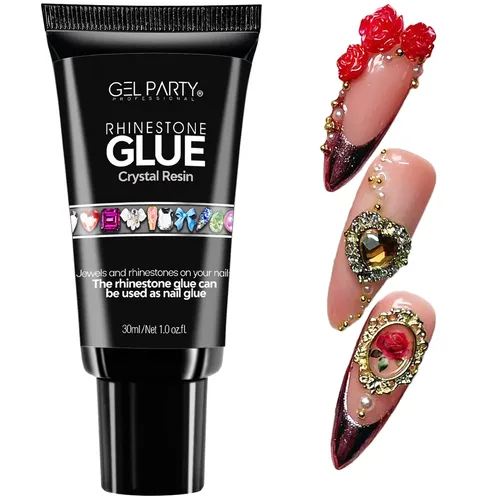
Rhinestone glue gel
Extra-thick gel that grips gems, pearls and 3D charms. Cure about 60 seconds under LED or about 120 seconds under UV.
Side-by-side comparison
| Brush-on glue | Semi-solid glue | Nail glue gel (tube) | Solid glue gel (jar) | Rhinestone glue gel | |
|---|---|---|---|---|---|
| Chemistry family | Cyanoacrylate (air-set) | Cyanoacrylate-type (air-set) | (Meth)acrylate gel | (Meth)acrylate gel | (Meth)acrylate gel |
| Texture | Thin liquid | Thick, jelly-like | Thick, controlled | Very thick, holds shape | Extra thick |
| Lamp needed | No | No | Yes, UV/LED | Yes, UV/LED | Yes, UV/LED |
| Working time | A few seconds | A few seconds (a little longer) | Until cured | Until cured | Until cured |
| How it sets | Press and hold 10–15 s | Press and hold 20–30 s | Flash 5–10 s, full cure about 60 s | Flash, then full cure | About 60 s LED, about 120 s UV |
| Best for | Press-ons, repairs | Press-ons at home, travel | Soft gel tips, French tips | Soft gel tips, beginners | Gems, charms, 3D art |
| Typical wear | Days, up to about a week | Days, up to about a week | Weeks | Weeks | Weeks (with the manicure) |
| Removal | Glue remover, warm soapy water or acetone | Glue remover, warm soapy water or acetone | File the shine, soak in acetone | File the shine, soak in acetone | Acetone soak or file around the stone |
| Risk of running onto skin | Higher | Low | Low | Very low | Very low |
Wear time depends heavily on preparation, nail growth and how you use your hands. Press-on nails applied with air-set glue last about a week on average.
How long each one takes to set
Time to set or cure (seconds)
Air-set (hold time)Lamp cure (full cure)
Upper end of the recommended time for each GEL PARTY glue. Air-set glues reach full strength over about an hour, so avoid water during that time. Lamp times vary with wattage: follow your lamp's guide.
Which glue for which job?
| Job | Best choice | Also works | Avoid |
|---|---|---|---|
| Press-on nails for a weekend or event | Semi-solid glue | Brush-on glue | Glue gel (removal takes longer than the wear) |
| Press-ons you want to reuse | Semi-solid glue, applied lightly | Adhesive tabs | Large amounts of brush-on glue |
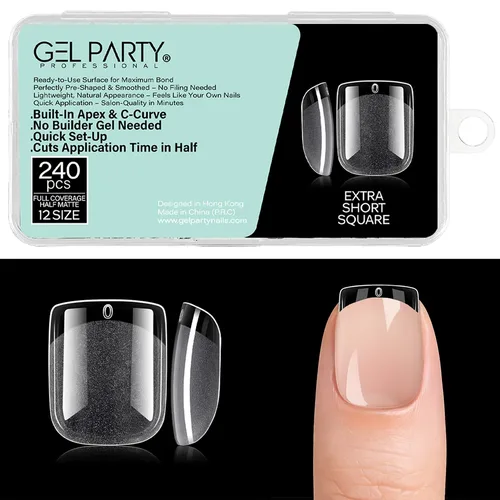
| Soft gel tip extensions for 3+ weeks | Nail glue gel (tube) or solid glue gel | Soft gel tip adhesive (brush) | Air-set glue (too rigid, lifts early) |
| First-time soft gel tips | Solid glue gel (jar) | Nail glue gel (tube) | Runny liquid glue |
| Quick fix for a cracked or split nail | Brush-on glue (thin layer) | Brush-on glue gel, cured | Thick semi-solid glue |
| Rhinestones, pearls and 3D charms | Rhinestone glue gel | Semi-solid glue for tiny flat gems | Top coat alone |
| French tips over a gel manicure | Nail glue gel | Brush-on glue gel | Brush-on cyanoacrylate over uncured gel |
How to apply nail glue correctly
Most "bad glue" is really bad prep. The nail plate needs to be clean, dry, oil-free and lightly textured, whichever glue you choose.
Step 1: Prep (the same for every glue)
- Push back the cuticles and remove non-living tissue from the nail plate.
- Buff away the shine lightly with a 180-grit file. Do not thin the nail. Brush away all dust.
- Dehydrate. Wipe with a lint-free pad and alcohol or a nail dehydrator. Don't touch the nail plate again, because skin oils cause lifting.
- Size every nail first. Lay out a press-on or tip for each finger before you open the glue. If you are between sizes, choose the larger one and file the sides.
Step 2: The 45° press-and-roll
The 45° press-and-roll
Placing the tip at an angle and rolling it down pushes air bubbles out toward the free edge. Trapped air shows as a white spot and causes early lifting.
Step 3: Set it, by glue type
Brush-on nail glue. Brush a thin layer on the natural nail and a thin layer inside the tip. Press on at 45° from the cuticle and hold firmly for 10–15 seconds. Shape the free edge if needed and avoid water for about an hour.
Semi-solid nail glue. Squeeze a small amount into the cuticle half of the press-on, or onto the nail. Press on at 45° and hold for 20–30 seconds. A little goes a long way: too much spreads onto the skin. Avoid hot water and heavy use for about an hour.
Nail glue gel (tube or solid jar). Apply a thin layer inside the tip, focusing on the cuticle area, or onto the natural nail. Press on at 45° and hold. While holding, flash-cure for 5–10 seconds (a handheld lamp is ideal), then do a full cure of about 60 seconds in the lamp. Then shape and finish with color or top coat.
Soft gel tip adhesive (brush). Apply a non-acid tip primer to the prepped nail, brush a thin layer of adhesive on the nail and inside the tip, press, flash-cure, then fully cure.
Rhinestone glue gel. Finish and cure your gel manicure first. Place a small dot of glue where each stone goes, set the stone with a wax pencil, draw a thin line of glue around its base without covering the top, then cure about 60 seconds under LED or about 120 seconds under UV. For large charms, cure from several angles.
How to remove each type of nail glue
The golden rule is the same for every glue: dissolve or soften it, never peel or pry it. Forcing a tip off rips away layers of the natural nail plate along with the glue.
| Glue type | Remove with | How long | Steps |
|---|---|---|---|
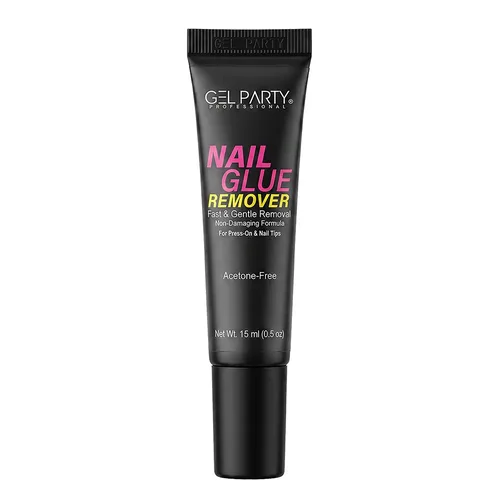
| Brush-on glue (press-ons) | Acetone-free glue remover, warm soapy water, or acetone | A few minutes; longer for a strong bond | Apply remover along the cuticle and side edges and under the free edge. Wait, then lift gently from the side. If it resists, reapply. |
| Semi-solid glue (press-ons) | Acetone-free glue remover | A few minutes | Apply around the edges, wait, then slide a cuticle pusher under the side and lift slowly. |
| Nail glue gel and solid glue gel (soft gel tips) | Acetone soak, or gel remover | About 10–15 minutes | File off the shine and some of the bulk, then soak or wrap in acetone. Slide the softened tips off gently. |
| Rhinestone glue gel | Acetone, or careful filing | About 10–15 minutes | Soak, or file carefully around the decoration and lift it off. |
After removal, buff away any glue residue gently, wash your hands and massage in cuticle oil. Acetone and glue strip moisture from the nail and skin, so rehydrate every time.
Troubleshooting
| Problem | Likely cause | Fix |
|---|---|---|
| Press-ons pop off within a day | Oily or shiny nail plate, glue applied too thin or too thick, or water too soon | Buff and dehydrate properly, cover the cuticle half evenly, avoid water for an hour |
| White spot under the tip | Trapped air bubble | Use the 45° press-and-roll and enough glue to fill the contact area |
| White haze around the nail | Cyanoacrylate vapor settling on surfaces (the same effect forensic labs use to reveal fingerprints) | Use less glue, work in a ventilated area, buff the haze off before top coat |
| Glue on the skin or cuticle | Too much glue, or a runny formula | Switch to semi-solid glue or solid glue gel. Remove it before it sets. Don't pick it off later |
| Soft gel tips lifting at the cuticle | Tip moved during cure, or skin oil on the plate | Flash-cure while holding, re-dehydrate, check that the tip fits wall to wall |
| Heat spike while curing | Thick glue gel layer curing fast | Use thinner layers. Pull your hand out briefly, then return it to the lamp |
| Tip cracks across the stress point | Air-set glue used for long extensions | Use a glue gel for anything longer than short, and keep enough product at the stress area |
Safety: what you should know
Keep it off the skin and out of the eyes. If fingers stick together, don't pull them apart. Poison-control guidance is to soak in warm soapy water, or use acetone, rubbing alcohol or an oil such as mineral or vegetable oil, and work the skin apart slowly. It can take a while. If glue gets in the eye, don't force the eyelids open. Rinse with water for 15 minutes and get medical help.
Allergies. Both families can cause allergic reactions in some people. UV/LED glue gels are built from (meth)acrylates, the same group discussed in our guide to HEMA-free and TPO-free gel nails. Nail and eyelash glues are a recognized source of acrylate sensitization, and fully curing every layer matters. Cyanoacrylate glues can also cause allergic reactions, although dermatologists note that cyanoacrylates generally do not cross-react with (meth)acrylates. If you notice itching, redness or swelling around the nails, stop using the product and see a dermatologist.
Don't over-wear. Leaving press-ons on too long, or letting water collect under a lifted tip, raises the risk of infection. Remove lifted nails promptly. If you see pain, redness or discoloration, consult a dermatologist.
Store glue properly. Close caps tightly. Moisture in the air slowly thickens air-set glue inside the bottle. Keep UV/LED glue gels away from sunlight and lamps, and keep all glues away from children.
GEL PARTY nail glues
We make one glue for every job. Each product page has full step-by-step instructions.
New to soft gel tips? Read our step-by-step guide on how to apply soft gel tips at home, and compare enhancement systems in builder gel vs poly gel vs acrylic.
Frequently asked questions
What is the strongest nail glue?
For long-lasting extensions, a UV/LED glue gel gives the strongest and most durable hold, because it cures into a tough, slightly flexible layer that bonds with soft gel tips for weeks. For press-on nails, brush-on and semi-solid air-set glues give a very strong instant bond, but cured cyanoacrylate is more rigid and usually lasts days rather than weeks.
What is the difference between semi-solid glue and solid glue gel?
Semi-solid nail glue is an air-set glue with a thick, jelly-like texture. It sets on its own in about 20–30 seconds, without a lamp. Solid glue gel is a very thick UV/LED gel adhesive that stays soft until you cure it in a lamp. Semi-solid glue is best for press-ons. Solid glue gel is best for soft gel tips.
Do I need a UV lamp for nail glue?
Only for glue gels: nail glue gel, solid glue gel, brush-on glue gel, tip adhesive and rhinestone glue gel. Brush-on nail glue and semi-solid nail glue set in the air, with no lamp.
Is nail glue the same as super glue?
Classic nail glue belongs to the same chemical family as super glue (cyanoacrylates), but it is formulated, packaged and tested for use on nails. Never use household super glue on your nails or skin.
How do I remove press-on nails without damaging my nails?
Apply a nail glue remover along the cuticle, the sides and under the free edge. Wait a few minutes, then slide a cuticle pusher under the side and lift slowly. If it resists, apply more remover and wait longer. Warm soapy water also helps. Never peel or pry.
How do I remove soft gel tips applied with glue gel?
File off the top shine and some of the bulk, then soak or wrap the nails in acetone for about 10–15 minutes until the tips soften and slide off. Finish with a gentle buff and cuticle oil.
Can I use nail glue to fix a broken natural nail?
Yes. Brush a very thin layer of brush-on nail glue over the crack and hold the edges together until it sets. You can add a thin layer of brush-on glue gel or builder gel on top for extra strength.
The bottom line
Match the glue to the job. Air-set glues (brush-on and semi-solid) are fast and easy to remove, which makes them ideal for press-ons and quick fixes. UV/LED glue gels (tube, solid jar, brush bottle and rhinestone gel) take a minute longer but give you control while you work and a hold that lasts for weeks. Prep carefully, use thin layers, cure fully, and always dissolve rather than pry, and your natural nails will stay healthy underneath.
This article is for general information. If glue gets in the eyes or mouth, or you notice a skin reaction, contact a poison center or a doctor.
Sources
- Duffy C, Zetterlund PB, Aldabbagh F. Radical polymerization of alkyl 2-cyanoacrylates. Molecules. 2018;23(2):465. doi:10.3390/molecules23020465 (moisture-initiated anionic polymerization, speed, water sensitivity, fingerprint fuming).
- Poison Control (National Capital Poison Center). Super glue: skin, eye and mouth exposures (loosening bonded skin, heat release, eye first aid).
- MedlinePlus, U.S. National Library of Medicine. Cyanoacrylates.
- British Association of Dermatologists. Dermatologists issue warning about UK artificial nail allergy epidemic (nail and eyelash glues, cyanoacrylate reactions, incomplete curing). 2018.
- Rodriguez I, George SE, Yu J, Adler BL. Tackling acrylate allergy: the sticky truth. Cutis. 2023;112(6):282–286. MDedge (cyanoacrylate vs. (meth)acrylate cross-reactivity, uncured monomers).
- Ochsner Health. Are press-on nails safe? 12 June 2024 (average wear time, infection risk, when to see a dermatologist).
- GEL PARTY product instructions: Semi-Solid Nail Glue, Super Nail Glue with Brush, Nail Glue Gel, Rhinestone Glue Gel, Nail Glue Remover (hold and cure times, removal steps).